Demystifying Wealth Creation: Strategic Financial Planning Guide | Samarth Capital
Demystifying Wealth Creation: A Guide to Strategic Financial Planning
When it comes to managing money, there is a massive difference between simply saving and strategically building wealth. For many individuals and families, navigating the modern financial landscape can feel overwhelming. With so many investment options available, how do you know which path aligns with your true life goals?
At Samarth Capital, we believe that financial clarity is the foundation of peace of mind. True financial growth is not about chasing short-term market trends; it is about understanding how different financial instruments work together to protect and multiply your hard-earned capital. Whether you are a high-net-worth individual looking for specialized oversight or a family planning for a stable future, mastering a few core pillars of wealth management will change how you look at money forever.
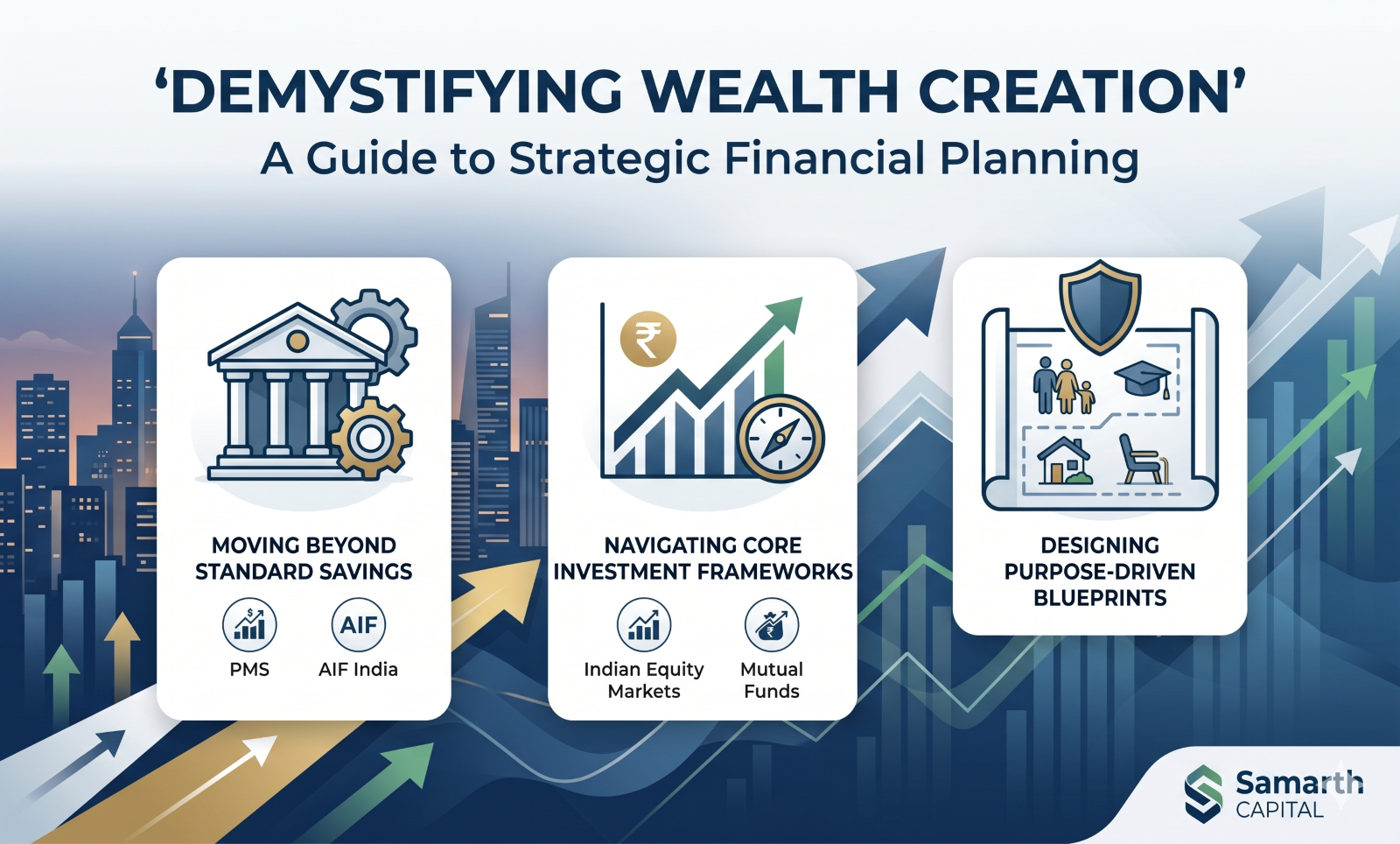
1. Moving Beyond Standard Savings: The Institutional Approach
As families accumulate significant capital, standard retail investment products often fall short of their complex financial needs. This is where high-tier structures like Portfolio Management Services (PMS) and Alternative Investment Funds (AIF India) enter the picture.
Unlike retail mutual funds, which operate under strict, uniform mandates, a PMS offers a directly owned portfolio of stocks tailored to specific risk-reward profiles. It allows for concentrated positions in high-conviction companies, giving investors a more direct stake in India's corporate growth.
On the other hand, Alternative Investment Funds (AIFs) cater to institutional minds and ultra-high-net-worth individuals by investing in asset classes beyond traditional stocks and bonds—such as venture capital, private equity, long-short hedge strategies, or real estate. For individuals searching for the best wealth management firms for HNIs, evaluating the accessibility of these institutional platforms is vital. Navigating these private markets requires deep expertise to balance the higher potential returns against the unique risks and lock-in periods involved.
2. Navigating the Core Investment Frameworks
For long-term wealth building, the Indian financial market offers two main entry points for growing your capital:
Indian Equity Markets
Learning how to invest in Indian equity markets successfully requires looking past daily stock market noise. Direct equity investing means buying partial ownership in a business. It requires deep research into corporate governance, balance sheets, and industrial cycles. For those who do not have the time to analyze individual stocks daily, professionally managed equity platforms offer an ideal alternative.
Long-Term Mutual Funds
Choosing the best mutual funds for long term growth 2026 involves looking closely at a fund's historical consistency rather than just its recent performance. Equity mutual funds pool money from thousands of investors to buy a diversified basket of stocks, managed by professional fund managers. Over extended periods, diversification shields your capital from the failure of any single company while keeping your portfolio aligned with India's broader economic expansion.
3. Designing a Purpose-Driven Financial Blueprint
True financial security is rarely built by accident. It is the result of structured, forward-thinking frameworks designed around your specific life milestones.
Goal-Based Financial Planning for Families
This framework connects every investment directly to a future family milestone—such as a child’s higher education, purchasing a home, or funding a wedding. Instead of asking, "How do I get the highest return?" goal-based planning asks, "How much money will we need in ten years, and what is the safest way to ensure it is there?" This approach prevents families from taking unnecessary risks with money they will need in the short term.
Retirement Income Strategies
Transitioning from earning a monthly salary to living off an accumulated corpus requires a total shift in mindset. Effective retirement income strategies focus on cash-flow sustainability and inflation protection. The goal is to set up a defensive asset allocation structure that generates stable, monthly distributions while allowing the underlying core corpus to keep growing behind the scenes, ensuring you never outlive your wealth.
4. The Impact of Legal Tax Optimization
A major, often overlooked leak in long-term wealth accumulation is unnecessary tax outflow. Many citizens view taxation as an unavoidable year-end chore rather than an ongoing core component of their investment strategy.
Utilizing professional tax planning services allows you to structure your investments legally from day one to minimize your tax liability. True income tax saving is not just about rushing to fill your Section 80C quotas in March. It is about understanding the tax implications of capital gains, utilizing tax-efficient funds, and structuring business or personal income to retain as much of your return as legally possible. Every rupee saved on taxes is an extra rupee that remains in your portfolio, compounding for your future.
Ultimately, the most reliable path to financial freedom relies on personalized wealth growth strategies. No two families share the exact same risk tolerance, income timeline, or life aspirations, which is why a cookie-cutter approach to financial planning rarely succeeds over time.
Frequently Asked Questions (FAQs)
Q1: What is the main difference between a Mutual Fund and Portfolio Management Services (PMS)?
Mutual Funds: Pool money from many investors into a collective fund. You own units of the fund, not the individual underlying stocks.
PMS: Provides a customized portfolio where the shares are held directly in your personal demat account. It offers higher customization and specialization, typically requiring a minimum regulatory investment of ₹50 Lakhs.
Q2: How do Alternative Investment Funds (AIF India) fit into a regular portfolio?
AIFs are designed for sophisticated investors looking for low correlation with the traditional stock market. They hold alternative assets like private equity or distressed debt. Because they require a higher minimum investment (usually ₹1 Crore), they function as a diversification tool for high-net-worth portfolios rather than a primary investment method.
Q3: Why is goal-based financial planning safer than regular investing?
Regular investing focuses entirely on chasing returns, which can lead to holding high-risk assets right when you need to withdraw your cash. Goal-based planning matches the maturity and risk level of your investments directly to the date you will actually need the money, protecting your near-term goals from sudden market drops.
Q4: Can long-term mutual funds completely beat inflation?
Historically, equity-linked mutual funds have been one of the most effective asset classes for beating inflation in India over 5 to 10-year horizons. While fixed deposits provide safety, they often fail to beat inflation after taxes, whereas equities capture corporate earnings growth directly.
Q5: When should a family start looking into retirement income strategies?
The best time to start planning your retirement income framework is at least 10 to 15 years before you actually plan to stop working. This gives you plenty of time to build up a stable corpus and transition smoothly from aggressive growth assets into reliable, tax-efficient cash-flow generators.
Connect With Us
To learn more about aligning your assets with your long-term life goals, feel free to reach out to our team for a personalized discussion.
Company Name: Samarth Capital
Corporate Office: 218 C-Wing, Prabhu Plaza, S V Road, Malad (West), Mumbai
Email Support: customercare@samarthcapital.in
📞 Contact Us: +91 98922 00201
🌐 Visit: www.samarthcapital.in
💬 Chat on WhatsApp: https://wa.me/+919892200201
Disclaimer: Investments in securities markets are subject to market risks. Past performance is not indicative of future results. Investors should carefully consider their investment objectives, risk tolerance, and financial circumstances before making investment decisions.